
PowerPC MPC56x NEXUS Debugger and Trace The embedded tools company


PowerPC MPC56x NEXUS Debugger and Trace

Picture

 
Support for NEXUS standard class 1 to 3
 
Easy high-level and assembler debugging
 
Interface to all compilers
 
Program and data flow trace up to 100 MHz
 
16/32 M * 128 bit trace depth
 
Trace contents readable while sampling
 
Code coverage
 
Performance analysis
 
Trigger programming
 
Interface to all hosts
 
USB and ETHERNET interface included
 
Support for

MPC533, MPC534, MPC535, MPC536, MPC561, MPC562, MPC563, MPC564, MPC565, MPC566


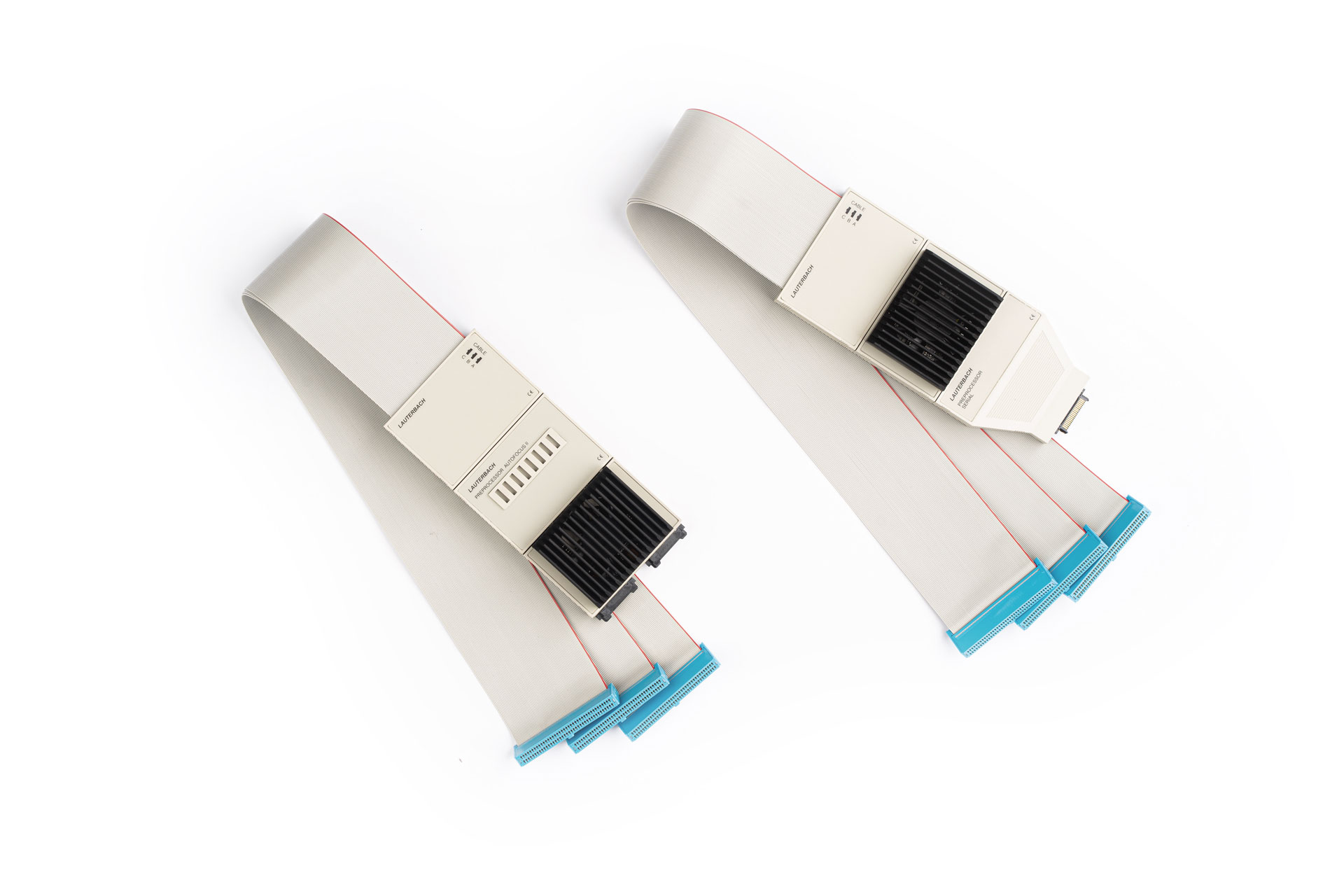
The Lauterbach product TRACE32-PowerTrace/NEXUS supports the NEXUS standard class 1 to 3. The hardware module for the NEXUS debugger is universal and allows to interface different target processors by simply changing the NEXUS adapter and starting a new software.


Link Doc
Download full document
nexusppc.pdf
(1022k)
Dim
Dimensions
Freq
Max. Operation Frequency
Volt
Operation Voltage
Faq
Frequently Asked Questions
Order
Order
Information
Support
Technical Support
Nexus Adaption for ETAS
Nexus Adaption for AMP50
Nexus Adaption for GA51
Nexus Adaption for MICTOR38


TOP       Nexus Concept


The PowerNexus Module includes all systems for trace and debugging. Controlled by an PowerPC controller with 200 MHz it gives max. performance for fast download and trace upload.

TOP       Controller

CPU

  • 200 MHz PowerPC
  • 64 MByte SDRAM

PODBUS Interface to PC, ETHERNET or TRACE32-ICE

Direct USB Interface

TOP       Active Debugger

High-Speed Download

  • Up to 800 KByte/sec


Variable Debug Clock Speed

  • Variable up to 100 MHz
TOP       Nexus Trace

Nexus Port

  • 40 Trace Channels for 100 MHz Operation

Trace Storage

  • 256/512 MByte Trace Storage
  • 16/32 MFrames
  • Full Dual-ported
  • 640 MByte/sec sample rate
  • Time Stamp 20 ns Resolution
  • Time Correlation and Tracking with other TRACE32 Tools

Code Coverage

  • Hardware Code Coverage
  • 4 Segments with 4 MByte each

Data Coverage

  • Hardware Data Coverage
  • 4 Segments with 256 KByte each

Shadow Memory

  • 4 Segments with 256 KByte each

Breakpoints

  • 4 Breakpoint Memory with 256 KBit each

Trigger Sequencer

  • 4 Trigger Levels
    • Goto
    • Continue
  • Trace Control
    • Enable
    • On
    • Off
    • Break
  • 3 Counters
    • Enable
    • On
    • Off
    • Restart
  • 2 Flags
    • On
    • Off
    • Toggle
  • 2 Markers
  • Break
    • Program
    • Trigger Bus
  • 2 Trigger Outputs

Trigger Delay

  • 0 .. 300 s

External Trigger

  • Input from PODBUS
  • Output to PODBUS

Performance Analyzer

Support for EPROM/FLASH Simulator

  • Breakpoints in ROM Area
  • 8, 16 and 32 Bit EPROM/FLASH Emulation

Context Tracking System

  • Single Stepping of realtime programs
  • Local and global variable display
  • Stack frame display
  • Step, Back Step and Stepover
  • Conditional Stepping
  • Display of register variables in trace
  • Display of function nesting with parameters in trace

SmartTrace

  • Fills in missing code
  • Direct branch reconstruction
  • Indirect branch reconstuction with CTS
  • Memory and Register values from CTS
TOP       IDE - Integrated Development Environment


ASM Debugger

  • Supports almost all file formats
  • Fast operation
  • Assembler source-level debugging
  • Advanced memory display
  • Inline assembler
  • Memory tests
  • Customizable windows
  • Peripheral windows
  • Terminal window
  • Semi-hosting
  • Flash programming
  • Full support for peripherals

HLL Debugger

  • Supports multiple languages
  • Full support for C++
  • Integrated into TRACE32 environment
  • Supports most compilers and hosts
  • Same user interface on different hosts
  • High speed download
  • Debugs optimized code
  • Display of function nesting
  • Display of linked lists
  • Fast operation
  • Powerful expression evaluation

Compiler Support

C

  • D-CC (Diab-Data)
    • IEEE
    • COFF
    • ELF/DWARF
  • CC (Freescale)
    • XCOFF
  • XCC-V (Gaio)
    • SAUF
  • GREEN HILLS C (Greenhills)
    • ELF/DWARF
  • GCC (HighTec)
    • ELF/DWARF
  • MCCPPC (Mentor Graphics)
    • ELF/DWARF
  • HIGH-C (Metaware)
    • ELF/DWARF
  • CODEWARRIOR (Metrowerks)
    • ELF/DWARF
  • ULTRA C (Microware)
    • ROF
  • DCPPC (TASKING)
    • ELF/DWARF

C++

  • D-C++ (Diab-Data)
    • ELF/DWARF
  • GCC (FSF)
    • ELF/DWARF
  • GREEN HILLS C++ (Greenhills)
    • ELF/DWARF
  • CCCPPC (Mentor Graphics)
    • ELF/DWARF
  • HIGH-C++ (Metaware)
    • ELF/DWARF
  • MSVC (Microsoft)
    • EXE/CV5
  • GCCPPC (Wind River Systems)
    • ELF/STABS

GCC

  • GCC (FSF)
    • ELF/DWARF

JAVA

  • FASTJ (Diab-Data)
    • ELF/DWARF

Memory Analysis

  • Display of allocated memory blocks
  • Memory allocation Statistics
  • Check for out-of-bounds writes
  • Trace of allocation calls
  • Graphical displays of memory usage

LIGHTSPEED Differential Download Technology

  • Up to 30 times higher download speed
  • Boost download speed on MPC8260, MPC8560 or MPC755
  • Boost download speed on low-frequeny devices
  • Boost download speed on serial ROM monitors

Peripheral Browser

  • Display of onchip peripherals
  • User definable windows
  • Interactive window definition with softkey support
  • Pulldown menues for selection of choices
  • Additional description for each field

MMU Support

  • Full integrated support of processor's MMU
  • Display of processor MMU registers
  • Display of MMU table entries
  • Display of address translation table
  • 'Shadowing' MMU address translation inside debugger
  • Full virtual and physical access to target at any time
  • Debugger has optionally write access to write protected memory areas
  • Detection and decoding of software MMU tables built by operating systems
  • Support for several user space MMU tables side by side
  • TLB context tracking and git statistics via CTS

PRACTICE Script Language

  • Structured Language
  • Menu Support
  • Command Logs
  • Custom Menues
  • Custom Toolbars and Buttons
  • Custom Dialog Windows
  • 64-Bit Arithmetic
  • Numeric, Logical and String Operators
  • Direct Access to System States

FLASH Programming

  • Internal and/or external FLASH memories
  • All common FLASH types
  • Programming of multiple FLASH devices
  • Provided by ICE, FIRE, ICD product line

SIM Instruction Set Simulators

  • Easy high-level and assembler debugging
  • Interface to all compilers
  • Trace Buffer
  • Powerful script language
  • Software compatible to all TRACE32 tools
  • Hardware simulation

Statistic Analyzer

  • Detailed analysis of function run-times
  • Detailed analysis of task run-times and state
  • Graphical analysis of variable values over the time
  • Analysis of the time interval of a single event (e.g. Interrupt)
  • Analysis of the time interval between 2 defined events

Coverage Analyzer

  • Long-Time Hardware Coverage Analysis for Emulator and ETM
  • Trace Based Coverage Analysis for ICD and Emulator
  • Analysis on ASM and HLL
  • Coverage summary on modul/function level

Performance Analyzer

  • Long-time performance analysis for functions
  • Long-time performance analysis for tasks
  • Long-time analysis of the contents of a variable or memory location and more

Debugger for TPU

  • Full support of TPU1, TPU2 and TPU3
  • Step and Go commands
  • Supports all TPU Breakpoints
  • Disassembler for Microinstructions
  • Monitor all TPU Registers during stepping
  • Modify TPU internal Registers
  • Display of Entry Points
  • Peripheral View of TPU Registers

Logger

  • Software trace of any size stored in an array structure on the target
  • General trace format provided by TRACE32-PowerView
  • Configuration and display commands provided by TRACE32-PowerView
  • Works as trace with address and data information
  • Works as a program flow trace (SH4, PowerPC)
  • Time stamp possible
  • Predefined algorithms to fill the trace provided by Lauterbach
  • User defined algorithms to fill the trace also possible

Snooper

  • Samples memory while application is running
  • Support for special debug communication channels
  • All trace display and analysis functions can be used
  • Trigger on specific values
  • Dynamic performance analysis
RTOS

RTOS Support

3rd Party Integration

3rd Party Tool Integration

Help System

  • Acrobat Based Documentation
  • Fast Text Search
  • Device Specific Filtering
  • Basic and Advanced Help
  • Training Manuals Included
  • WWW Update
TOP       Connectors

Adaption for NEXUS Debugger on ETAS board

  • AMP 104549-6 40-pin

Adaption for NEXUS Debugger on AMP50 (Non Robust)

  • Low-Cost Connector
  • AMP 104549-7 50-pin

Adaption for NEXUS Debugger on GA51 (Robust)

  • Robust Connector
  • Glenair MR7580-51P2BNU

Adaption for NEXUS Debugger on Mictor

  • Provided by Lauterbach - no NEXUS standard
  • AMP 2-767004-2
  • AMP 767054-1
  • AMP 767061-1
  • AMP 767044-1 : Board-to-Board Type: Coplanar
TOP       Configuration Examples


NEXUS Debugger on PC or NOTEBOOK Get Quote

 
Podbus Parallel Interface
NEXUS Debug Module
 

NEXUS Debugger and EPROM/FLASH Simulator on PC or Workstation Get Quote

Hub 10-Base-T or 100-Base-T
NEXUS Debug Module
EPROM/FLASH Simulator Module
 

NEXUS Debugger on PC with USB Interface Get Quote

 
USB2
NEXUS Debug Module
with USB Interface
 

NEXUS Debugger on PC with USB Interface Get Quote

 
USB2
NEXUS Debug Module
with USB Interface
Mixed Operation JTAG/NEXUS
 

NEXUS Debugger and EPROM/FLASH Simulator on PC with USB Interface Get Quote

 
USB2
NEXUS Debug Module
with USB Interface
EPROM/FLASH Simulator Module
 

NEXUS Debugger and Timing/State Analyzer on PC or Workstation Get Quote

Hub 10-Base-T or 100-Base-T
NEXUS Debug Module
Extension Cable
State/Timing Analyzer
 

NEXUS Debugger and Timing/State Analyzer on PC or Workstation Get Quote

Hub 10-Base-T or 100-Base-T
NEXUS Debug Module
Timing Analyzer SOC (ASIC/FPGA)
 

NEXUS Debugger and additional Trigger Probe on PC Get Quote

Printer Cable
Parallel Interface
NEXUS Debug Module
Trigger Probe


Navigation
Copyright © 2008 Lauterbach Datentechnik GmbH, Fichtenstr. 27, D-85649 Hofolding, Germany  Impressum
The information presented is intended to give overview information only.
Changes and technical enhancements or modifications can be made without notice.
Last generated/modified: Jun-18-2008